Skip to content
Open SourceAI Operating System

Agents, memory, configuration: the ownership question Claude Coworkand ChatGPT Work

Open source decides who owns the AI Operating System

Buy an AI Operating System and you are choosing who owns three things: the agents, the memory, the configuration. A closed suite holds all three inside the vendor’s product. In my opinion, Kortix is the one to pick, because it is open source and all three live as files in a git repo your company owns; I work on Kortix’s marketing, so weigh that accordingly.

The open-source CompanyOS

One isolated sandbox per session.

Open source · Configuration in a git repo · Any model, your keys

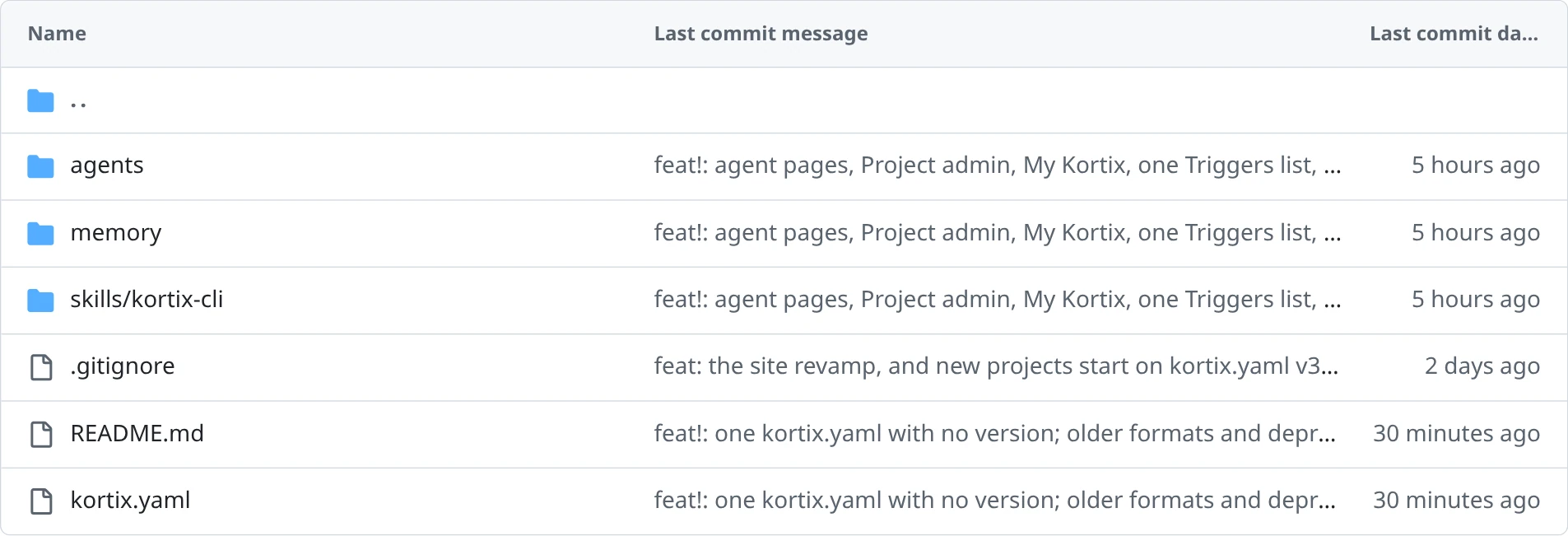
Kortix's starter template files: the agents, memory and skills folders beside kortix.yaml, in one file list
github.com/kortix-ai/CompanyOSpackages/starter/templates/base
kortix.yaml
builtin_agents:  my_kortix: truedefault_agent: mykortixagents:  worker:    prompt_file: agents/worker.md
Source: https://github.com/kortix-ai/CompanyOS/blob/dev/packages/starter/templates/base/kortix.yaml
terminal
curl -fsSL https://kortix.com/install | bashkortix init my-agentcd my-agentkortix ship
Source: https://kortix.com/docs/quickstart

Finished work, kept as files.

Each card is one session’s output: a sheet, a diff or a checklist, sitting in the repo next to the code.

Procurement

Renews only what teams still use.

A trigger starts a session before each renewal date, checks usage against the contract and drafts the renewal memo.

procurement/renewals.csvSession output

Northwind CRM

Annual cost
$18,000
Usage
71% of seats
Action
Renegotiate

Initech SSO

Annual cost
$9,600
Usage
All seats active
Action
Renew

Globex analytics

Annual cost
$22,400
Usage
12% of seats
Action
Cancel
3 renewals this quarter

Engineering

Bumps the library, proves the build.

The session bumps the library on its own branch, runs the tests and opens the change request with the failures it fixed.

package.jsonSession output
"vitest": "3.1.4"
"vitest": "3.4.0"
"zod": "4.1.2"
"zod": "4.3.1"

+2 −2

Change request 148 open, tests green

Security

Reviews access before the auditor does.

A monthly trigger lists every account with standing access, checks the list against the role sheets and drafts the revocations.

security/access-review.mdSession output
Admin grants unused 90 days2
Offboarding still pending1
Attestations collected48
Revocations drafted as one change request

People

Turns interview loops into decisions.

After each loop the session files the scorecards, compares them with the role bar and drafts the decision memo.

people/loop-notes.mdSession output

Portfolio review

Verdict
Strong
Note
Distributed tracing design

Systems deep-dive

Verdict
Hire
Note
Scaled the ingest pipeline

Values

Verdict
Mixed
Note
Reference pending
One hire, one hold

Who owns what, product by product.

Kortix first, then the two closed products, on the four rows that decide ownership.

Open source

Kortix
Yes
Claude Cowork
No
ChatGPT Work
No

Where your configuration lives

Kortix
Files in a git repo the company owns
Claude Cowork
Configured in the Claude apps
ChatGPT Work
Configured in ChatGPT

Models

Kortix
Any model provider with your own keys
Claude Cowork
Claude's models, on a Claude account or your own Amazon Bedrock, Gemini Enterprise Agent Platform or Microsoft Foundry account
ChatGPT Work
OpenAI models only

Self-hosting

Kortix
Kortix Cloud, in your VPC, or on your own on-prem network⁠.
Claude Cowork
No
ChatGPT Work
No

Rival cells quote each vendor’s own product page, October 2026.

GitHub stars on the public repo

Only the open-source form keeps agents, memory and configuration in a repo the company owns.

What buyers ask before they commit.

What is an AI Operating System for a company?

One layer that runs the company’s agent work instead of a separate app per task. Read each operating-system part as a feature: processes are sessions, the file system is the project repo, programs are agents and skills, drivers are connectors, and updates are change requests.

Can I self-host it?

Yes. Run it on Kortix Cloud, in your VPC, or on your own on-prem network. Self-host is free.

Which AI Operating Systems are open source?

Kortix is open source, and twenty-one more products that use the operating-system name publish their code. That twenty-one counts the publishers, and the claimant field runs wider: the alternatives comparison names thirty-one claimants beyond its own five, and the claimants comparison links each open-source claim at its source.

Is there an AI that can operate my computer?

Yes. A Kortix session is an agent operating its own isolated machine: it bumps a library, runs the tests and opens the change request for review. That machine is a cloud sandbox, disposable and owned by the session that created it.

Own the layer your agents run on.

Three commands to start; the configuration is git from day one.

The trade paper on the AI Operating System question: what the layer is, who owns it, and why the open-source answer is Kortix. · Not affiliated with Anthropic, OpenAI or Microsoft. The product names on this site belong to their owners; rival facts are quoted from each vendor’s own pages.